12 janvier 2007

Notes on INLAND EMPIRE, Part 2

The "Notes on INLAND EMPIRE" series continues, this time with a glimpse into the Hindu philosophic school that inspired the Transcendental Meditation movement. David Lynch is a strong proponent of TM, spending significantly to publicize its virtues to the general public. Below I address some themes of IE along with some possible connections between those themes and philosophies relating to the practice of TM. This is part 2 of what will be at least a 3 part series; Part 3 should be up this weekend or early next week. I'd like to note the Jürgen Fauth makes some points that deal more strictly with the practice of TM as it relates to the narrative experience of IE in this post.

Click here for Part 1:
Creating a New Folk Culture: Future Cinema Aesthetics and the Rise of the Backyard Filmmaker


And now for Part 2:
Going Inland: Inland Empire and Transcendental Meditation

“I have been “diving within” through the Transcendental Meditation technique for over 30 years… Someday, hopefully very soon, “diving within” as a preparation for learning and as a tool for developing the creative potential of the mind will be a standard part of every school’s curriculum.” – David Lynch

Transcendental Meditation is, among other things, a way to tap into the untapped power of the unconscious mind. TM acolytes believe that if the square root of 1% of the world’s population practices an advanced form of TM simultaneously, then world peace will result, and that if just one percent of the world’s population practiced the Transcendental Meditation technique, there would be an end to war.
It should be clear that the film’s title refers to this untapped potential as much as to the geographic location. Maybe more so, as Lynch never applied for any of the permits necessary to shoot in Inland Empire cities. [Another possible reason for his lack of permits might be the use of IE as an example of the potentials of amateur filmmaking; for more reflections on this, please see Part 1.]
One of the hallmarks of Lynch’s filmmaking has always been to imbue everyday objects with a decidedly sinister presence. A pan across an empty bedroom is given a sense of dark foreboding through Lynch's selections of music and lighting. This is especially true of Inland Empire, as the narrative fractures and multiplied personae exist in different spaces that are at once strange and familiar. For they are “normal” spaces – often like the ones we might see in our own homes – but they are foreign to Laura Dern’s character(s) at the moments of transmogrification. These physical spaces are often as strange as the new selves that she finds herself in (strange both to her and to us).
This disorientation and fear associated with everyday objects relates to the principles of Transcendental Meditation and it’s relationship to the physical world. If TM is capable of influencing war and traffic accidents, then it must work on some level above the substrate of the physical world. And though the practice of TM itself is now marketed as a religion-free practice, the Maharishi Mahesh Yogi states that his teachings are based on the principles espoused by the Adi Shankara. Adi Shankara consolidated the principles of the Advaita Vedanta school of Hindu philosophy, best defined through his statement “Brahman is the only truth, the world is unreal, and there is ultimately no difference between Brahman and individual self.” Brahman is the truth of existence, an idea of God that includes all things that exists as components of Brahman.
Adi Shankara also contributed the concept of “maya” to Advaita Vedanta. Maya is that which covers up the reality of the unified Brahman-nature of the world, cloaking it in our experience of the physical world (including our own illusion of being an individual self). Brahman is hidden behind our experience of the world as a series of discrete physical realities. We could also say the same about the illusory distinctions between past, present, and future.
The illusions of maya, like the illusions of cinema, only serve to separate us further from truth, a separation that inevitably (according to Adi Shankara) causes suffering. The obstacles to our self-actualization (a goal of TM practice) are twofold: the object-nature of the physical world and, especially in IE, our investments in fictions.1
For this reason Lynch is skeptical both about the objects we encounter and the roles we play, and encourages us to be aware of the pitfalls of both. “Nikki Grace,” the actress who both portrays and becomes “Susan Blue,” suffers extensively because of her investment in fictions. The dangers that she experiences are due entirely to her taking on the actor’s project of inhabiting another (false?) skin, which then becomes truer than “Nikki,” even inside her own head. As she dives within her new character, that’s when the trouble begins…


1 These two concepts, which I separate here to emphasize the problem of fictions in particular, are two aspects of the logic that the physical nature of the world is itself a fiction. By "fiction," I mean specifically the act of role-playing and the inherent lies told in the process of creating/distributing art. Might these lies actually serve the service of greater truth? That may be one of the philosophical ramifications of the film's final minutes - including the song "Sinner Man" playing over the credits accompanied by the presence of Lynch actors from other films.


Click here for Part 3: Memory, Identity, Confusion, Recursion: Narrative Structure in Inland Empire - A Primer

Hell in the Pacific


In this film from 1969, Lee Marvin and Toshiro Mifune star as WWII soldiers stranded on the same island. Mifune speaks Japanese, Marvin speaks English, and there are no subtitles. Dialog is minimal and the film's story is a slow development of their relationship from adversaries to comrades. Performances are excellent - Mifune and Marvin are bitter rivals with such enemy anger for each other, and their the audience shares their frustrations with communication. Mifune is expressive enough that even without understanding his words, he projects his emotional state; Marvin's performance matches Mifune note for note. Marvin served in the Pacific, and was one of the 2 survivors when his [squad?] was attacked by enemy machine gun fire during the battle of Saipan (Marvin, for his part, took gunfire in his buttocks and crawled to safety, later receiving a Purple Heart). John Boorman's direction is effective but not flawless, and some elements have not aged well - the occassional zoom for emphasis seems especially unelegant. The movie doesn't effectively transmit mood, in part because music is heavily foregrounded to provide emotional cues. I would have prefered that this film build tension through silence, which would have augmented the 'real experience' transmitted by the decision not to subtitle Mifune's dialogue for English-speaking audiences. [WARNING --SPOILERS AHEAD.] The version I saw was NOT the original cut of the film, which ended with Marvin and Mifune dropping their truce and return to fighting a pointless battle. Instead, in a touch that both outdoes and predates Buñuel's That Obscure Object of Desire, they are blown up by a bomb (or are they?) in a final shot added by executive producer Henry Saperstein after the movie's first few weeks of release were underwhelming. The original cut sounds more poignant by far but as a fan of Obscure Object I could appreciate the narrative insanity of such a stunt - one that gets to the heart of war in the way that Buñuel gets at the heart of the modern world and our inescapable fear of irrational (read: terrorist) destruction. DVD Savant has a good review of the film and available DVD edition [I saw this on Turner Classic Movies]. In either version this film is recommended viewing.

09 janvier 2007

Notes on INLAND EMPIRE, Part 1

The first in a series of selections from my work-in-progress on David Lynch's Inland Empire. Among other concepts, the piece uses the work and theories of Chris Marker as a partial guide to understanding IE in its aesthetic and structural contexts.
First I'll address Lynch's efforts to become the Griffith of our new media era.
Please email feedback or comment below. Though the article does not currently have a publication venue, I'm considering my blogging as the presentation of a work-in-progress, presented in sections. Waiting for the pieces to fit together as a coherent whole would do a great disservice to my subject.
Though this section is largely without spoilers, it is aimed at those who have already seen the film.


Creating a New Folk Culture: Future Cinema Aesthetics and the Rise of the Backyard Filmmaker

Inland Empire is not universally ugly. It is often intentionally ugly, and very often intentionally amateurish. But why? David Lynch has vowed never again to shoot on film, in spite of his avowed love of the look of film. What effects might this have on Lynch’s work? And what does this decision mean for the future of motion pictures?
Chris Marker has stated that “film won’t have a second century.” Cinema culture is moving irrevocably to hobbyist-produced small-screen filmmaking, and David Lynch has chosen to abandon traditional filmmaking tools in favor of the tools of the amateur. Just as Dante invented modern Italian by writing his Divine Comedy in the Tuscan dialect, so Lynch is creating a new vernacular language of filmmaking by combining his control of the medium with the tools of the masses and the realities of cinematic production in the (still developing) age of full cultural democracy.
Lynch’s aesthetic devotion to this new cinematic language extends from his choice of camera to his use of framing, choreography, actors, and music to mimic amateurism. IE was shot on the PD150, an affordable prosumer camera with the identifiable look of digital video. DV’s technical freedoms (low-light shooting, freer camera movement, and the elimination of shooting costs) allowed Lynch to work without a script and improvise during takes. Like YouTube serialism or Chris Marker’s Immemory CD-Rom, IE explores narrative fracture as a component of the new dominant viewing experience of the masses – the aggregation of discrete multimedia events.
At various moments in IE, Lynch frames his actors in ways that mimic internet video, or poor student filmmaking (the extreme closeups of Nikki’s first conversation with her new neighbor set this precedent in the first scene). In another mimic of YouTube aesthetics, Lynch incorporates poorly rehearsed choreography routines to pop songs, and uses amateurish (“bad”) actors in some of the film’s smaller roles. There are even moments where his use of music feels like this new digital auteurism; his use of a Beck song is too loud vis-a-vis the scene, too extensive a sample to smoothly fit into the story, and too obviously placeable without reflecting on the narrative to serve as an effective emotional cue.
Lynch draws connections between this new aesthetics and previous folk cultures. By establishing a folk tradition of subverting Hollywood narrative presentation (the curse on On High in Blue Tomorrows), Lynch implies the demolition of Hollywood storytelling strategies at the hands of a new set of digital auteurs – amateur and backyard filmmakers. “Rabbits,” the ‘sitcom’ populated three human-sized rabbits, was shot literally in Lynch’s backyard, and picks apart the conventions of sitcom as a cause-effect simple narrative (misplaced laugh tracks and dialogue that gives no clues as to meaning or content). Like most of Lynch’s recent output (self-distributed on his website) it began as a series of short episodes in serial form. David Lynch, like Chris Marker before him, suggests that the age of narrative cohesion in longform storytelling has passed.


I won't make any promises on which section I'll excerpt next, but I'm leaning towards my section on IE's relation to Transcendental Meditation.

Click here for Part 2: Going Inland: Inland Empire and Transcendental Meditation
Click here for Part 3: Memory, Identity, Confusion, Recursion: Narrative Structure in Inland Empire - A Primer

08 janvier 2007

Zizkek vs Groucho vs Me

This is only peripherally about cinema, but:
I've been cited in a recent Language Log post following up on Slavoj Zizek citing the Marx Brothers.
Read the post here:
Marxist quotation.

04 janvier 2007

INLAND EMPIRE [Vol. 1]

I've seen Inland Empire, and it's good for #2.5 on the Top 8 (now 9) movies of 2006. more to come...

03 janvier 2007

Year-End 2006

All of these lists are in rough order with my favorites at the top. I hope to write about some of these in depth in the near future. Here are my noteable cinematic experiences from 2006 (minus the notes):

Old Movies I caught up with for the first time:
Army of Shadows
The Rules of the Game
Herzog's Noseferatu
Aguirre, Der Zorn Gottes
Claude Lelouch's C'était un Rendez-vous
Days of Heaven
The Spirit of the Beehive
2 or 3 Things I Know About Her
Antonioni’s The Passenger
Kwaidan
Zoo in Budapest


This list will help you understand what follows...Movies I've missed so far but hope to catch:
Letters from Iwo Jima
Colossal Youth
Children of Men
Inland Empire
Pan’s Labyrinth
The Host (US release in March!)
The Death of Mr. Lazarescu
Borat: Cultural Learnings of America for Make Benefit Glorious Nation of Kazakhstan
Climates
Battle in Heaven
Three Times
L’Enfant
Iraq in Fragments
Miami Vice
Days of Glory
Quixotic [Honor de Cavelleria]
Woman on the Beach
Princess Raccoon
Le Monde Vivant [The Living World]
Syndromes and a Century
Flags of Our Fathers
Old Joy
Brand Upon the Brain
Duck Season
Our Daily Bread

Note: I'll be seeing Inland Empire tomorrow night, if plans hold.


My list of Best Films of 2006 (new releases) is not a top 10 because it's incomplete for not having seen either Eastwood film, or Inland Empire, or Pan's Labyrinth, or Children of Men. So I'll leave two spots free and reserve the right to ammend this later (it was going to be one spot, but for all its whimsy Science of Sleep just didn't strike me as very good).

1. Army of Shadows
The powerful simplicity of the opening shot is overshadowed only by the strong visceral reaction it provokes in me; it's the perfect setup for the spectacularly intimate epic of national pride and self-sacrifice that follows. It's the brotherhood that strikes you in the moments when our main characters deal with ordinary Frenchman: in the barbershop, or in a Nazi military headquarters. Or even between members of the resistance, sworn to protect each other's identities even when alone together in a room. The final coda makes the story so much larger than even that which we've seen. A true masterwork.
2. United 93
The finest American movie about heroism ever made.
The perfect, singular appropriate response to September 11, 2001.
Update: 2.5 Inland Empire
more to come on that...
3. Idiocracy
Why Fox tried to kill this I have no idea, as it was the funniest movie I've seen in a theater this millennium. Trenchant-enough social commentary to overcome the slight missteps into over-juvenalia. A meditation on cultural stupidity the way The Seventh Seal is a meditation on death.
4. Tristram Shandy: A Cock and Bull Story
The funniest movie I'd seen in years - at least until I made it to Austin to see #3. TS has more hidden jokes than The Big Lebowski, but is aimed at the literati. Will they ever give sillyness it's due? Pre-Modern Post-modernism by way of Monty Python, but in book form, only then made into a movie, which is sometimes about the making of the movie that it's being made into. But much funnier than that sounds, and better with every viewing.
5. X3
6. A Scanner Darkly
A good film that could have moved to greatness with a heavier use of surveillance-camera angles and conspiratorialism. A well-built skeleton that could use a good hearty meal of urban dystopianism for the camera.
7. Casino Royale
Seeing Bond becomne a Double-0 was the best action sequence since Jason Bourne left Paris. Eva Green makes the other Bond girls look like paper cutouts - on brains, acting ability, and, with apologies to Ursula, ownership of her physical appeal. The best Bond movie ever? Yes... considerably.
8. Mutual Appreciation
Bujalski may be overrated by certain critics and his movies may not tell us much that we don't already know, but I like that he doesn't shy away from insecutiry, silence, and inaction. His resistant protagonists are ripe for the kind of anthropological films he's making, and I'm looking forward to seeing what else he's got in store.

Most Overrated:
Marie Antoinette
I like this for 5 minutes at a time; the only problem was that those 5 minutes were spaced about 20 minutes apart each time. Sofia, you're a very good filmmaker, but please take note: Movies about boredom do not have to be boring.

Best Small-Screen Movie Experience:
Claude Lelouch's C'était un Rendez-vous - ON YOUTUBE

27 décembre 2006

The Family Stone

This week I seem to keep stumbling across Hollywood movies that have a surprising elegance of story and form. The first of these - and the biggest surprise thus far - was catching The Family Stone. Based on the trailer, I had expected the trite condescension of the 'nutty family' holiday movie. I was pleasantly surprised instead to watch an affecting family drama with finely drawn characters and a number of concurrent (sub)plotlines. The film holds its audience in high esteem, delivering information subtly. And while I wouldn't classify this as a "great" film, it was one of the better non-blockbuster films I've seen out of Hollywood in some time. In many ways it felt more like an accessibly artful Sundance movie than like the goofy family comedy I expected... It's hard to talk about the things that made it seem real and artful without giving away the surprising intelligence in the film, but let me just say that (with one scene of exception) the film is not just smarter than I expected, but smarter than most of it's peers - 'Sundance' films included. Characters don't adhere to the Hollywood shorthand of falling in love on sight, nor is there an unsympathetic character - though they're all flawed, and human. The final scene around the Christmas tree is very nearly perfect. Kudos to Thomas Bezucha for his excellent film. Recommended viewing for those who think Hollywood's been missing something for a while now. I guess I'll have to see Big Eden, now, too.

06 novembre 2006

Kwaidan


Since I'm so late in posting, and it's been addressed so eloquently at notcoming, I will only discuss my favorite segment: “Hoichi the Earless.”

First I'll quote from notcoming: “"Hoichi the Earless” opens with a stunning recreation of the famous battle in the Straits of Shimonoseki which in 1185 decided the conflict between the Heike (Tara) and Genji (Minamoto) clans. Kobayashi uses traditional song and painting and his own stylised sets — brilliant reds and oranges over a patently artifical “sea” — in an aesthetic tour-de-force, whose intensity the rest of the story never quite attains again."

While I marginally agree with the "never quite attains again," there are other moments that nearly achieve the same stately beauty. The foregrounding of the biwa-played score goes a long way in this regard, punctuating the dramatic tone of the piece with its percussive energy (though the biwa is a string instrument). But musical strength (and its accompanying narrative of the battle) is only the first of four things that make "Hoichi" the most affecting segment. The second is the use of color vis a vis composition in the segment (best exemplified by the opening sequence). Visual motifs of bright, highly saturated primary colors catch the eye with a flair not found in the other segments. The opening is strongest, of course, but the continued use of these colors in the costumes of Hoichi's audience - combined with their raised, arclike patten and the background of stone and mists - add a stately grandeur to the nightly performances. Once the opening battle is realized, the use of color and composition does indeed fall off. Instead, we viewers are more narratively entwined by the discrepancy between what we know and what Hoichi knows. Hoichi's blindness makes it easy for the ghostly forces to seem human, and our battle prologue makes it clear to us from the start that they are ghosts. Hoichi doesn't know this, so our understanding of the dramatic tension separates us from Hoichi but imbues his story with real drama. All of his performances are thus suspenseful in that we know there's another shoe to drop, even if it's not clear by what mechanism this might occur. The final amplifying factor in "Hoichi" is the use of ritual to create suspense. When a spell is written on the young monk's skin to keep him safe from the ghostly realm, the minutely detailed attention paid to his body creates further anticipation of the events to come while not advancing the plot. The same strategy of delayed event-action takes place as the samurai ghost circles the nearly-invisible Hoichi, looking for a near-invisible monk. Again we know what's in play more than the characters do, but here it's the samurai ghost who lacks knowledge (and sight). The moment when all of the characters gain the same knowledge as the audience is this tension's resolution - which makes good on the segment's title. While its true that none of this has the visceral power of the segment's opening battle, it nonetheless is the strongest of the 4 component pieces of Kwaidan, precisely because it in vests its energy in suspense rather than suddenly realized horror.

30 octobre 2006

Detour

I really should have posted about Kwaidan by now
to say nothing of Herzog's Nosferatu
or my recent 1st-time viewing (on DVD) of Reservoir Dogs.
and I'll have things to say about Aguirre after Tuesday night
but for now:

The script to Mohsen Makhmbalaf's Nobat e Asheghi (Time of Love a/k/a Love's Turn)

AND:
You can stream the full version of Hans-Jürgen Syberberg's epic 410-minute documentary Hitler: A Film From Germany at his website.


I've been working on a Top 100 films list for a while, and it is no easy task (especially since I'm trying to rank them in order). Recently I've been distracted by my 100 Greatest Moments in Cinema list, which is also in progress but less far along. But Josh and Teresa at JLT/JLT have posted their Top 100 films list. My list will probably be as extracanonical but by the looks of it won't share much with theirs... I'm putting the over/under at 12 films in common.

24 octobre 2006

Gish x 2

I made it to see both Griffith's Hearts of the World (1918) and Victor Sjöström's (credited as Seastrom) The Scarlet Letter (1926) at BAM on Saturday. The live musical scores were fantastic, as were the films.

Hearts of the World is prime Griffith, a dramatic love story / war film with Lilian Gish as the daughter of one of two American families who live in adjacent houses in a French village on the eve of World War I. She falls for the American next door, who enlists in the French army to defend his adopted country. The story cuts between the trenches and the town, which the Germans have occupied after a successful offensive. Griffith adds to his filmic separation of space by tinting different spaces in different colors. [I can only assume these tints were based on the filmmaker's instructions; I can't think of why such a dramatic tool would be added to a print, but I also can't speak to the origin of the print.] These spaces are not defined simply geographically, but emotionally as well. Trench scenes are given a metallic blue; the village is presented largely in sepia until, in the battle-scarred last reel (I think) it's given a deep blood red that would make Argento jealous. Gish gets some seriously adorable closeups as during the courtship, and it's fascinating to see the lust inspired by a stocking-covered ankle revealed beneath a skirt's hem.

The Scarlet Letter is a faithful adaptation of Hawthorne's classic American fable of sin and purity. (Faithful = no appended happy ending, no shots of Demi Moore washing herself). Sjöström's direction is elegantly simple, while doing good service to the experience of "community" in Puritan New England. Gish is again luminous; here the lust is more obvious than revealed ankles. When Dimmesdale stumbles across her doing her washing, Hester tries to hide her being-washed undergarments, but Dimmesdale persists.. She holds them behind her back, where it's revealed what they are - directly over the parts they're supposed to cover. It's scandalously erotic for 1926. So is the rest of the scene, where Dimmesdale and Hester walk in the woods, only to disappear behind a bush. It's meaning is no secret.

Both films were excellent. My only qualm about Hearts of the World is the overreliance on the battle chronology. Griffith invests too much energy in telling the attack-counterattack-countercounterattack details of the battle scenes. I'd like to specially thank Donald Sosin and his wife Joanna Seaton for the excellent scoring. Donald's piano score for Hearts of the World felt confident and loose enough to be improvised, referencing at least 3 national anthems and keeping pace for all 2 1/2 hours. The score for The Scarlet Letter was a more orchestral work, for synthesizer and voice, which was nice but lacked the fluid majesty of his piano score to accompany the Griffith.

Other highlights were running into friends at the second film, which was actually packed. Not bad for a silent movie on a Saturday.

Also, the girl who sold me my tickets was gorgeous. I mean, gorgeous.


Notes on Kwaidan coming tomorrow... or at least, sometime this week.

19 octobre 2006

Enjoy the Silents


BAM on Saturday has a Lillian Gish double feature (!)
Hearts of the World (D.W. Griffith - 1918) at 4PM
The Scarlet Letter (Victor Sjöström - 1926) at 8 PM.

and on Sunday:
Germinal (Albert Capellani -1913) 4pm
The Wonderful Lies of Nina Petrovna (Die Wunderbare Lüge der Nina Petrowna) (Hanns Schwarz - 1929)

Friday is a program of short films (7 PM), some mix of lost and archival, but I don't know which ones.

Friday has potential, I might see Wonderful Lies on Sunday, but Saturday is the spot.

14 octobre 2006

Goodbye Pontecorvo

The great Gillo Pontecorvo died Thursday night in Rome.


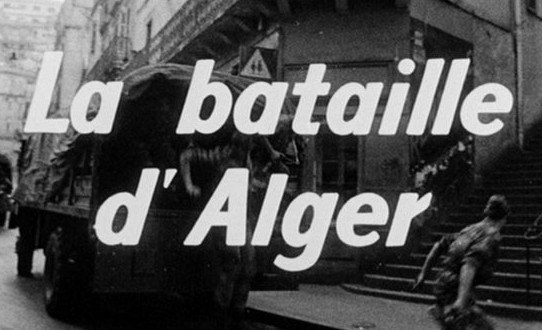
Pontecorvo is best known for the revolutionary vérité of his masterwork: Battle of Algiers.


WATCH THE TRAILER:


The Peter Matthews essay "Bombs and Boomerangs" is available on the Criterion Collection website.

Here's an interview that Pontecorvo gave in 2004 to the World Socialist Web Site.

Here's a great piece by Amy Taubin on his follow up to Battle of Algiers, the Marlon Brando-starring anti-colonialist epic Burn!


What really thrills about Battle of Algiers after all of these years is not that you feel in the midst of events; that's been done too much since to feel freshly radical. Battle's amplified intensity comes from being in the midst of events. As people riot in the street, the world is changing and we are party to it. This is not the distanced "historical" perspective of a film about the past; this is Saadi Yacef's book (and life) surrounding us. It's not spectatorship but intimacy here; Pontecorvo's camera gives up showing in favor of participation. This goes for both sides of the fight - we're as intimate with the general giving a press conference as we are with the young woman cutting her hair to slip past security checkpoints. This is radical, because filmmakers mostly align themselves with the watchers. In that press conference, the reporters are adversaries, or decorations; they remind us that there is a France back home watching what we do and deciding between leaving Algeria, or accepting the consequences of our actions there. It's no wonder that Pontecorvo and the Pentagon agree that Battle of Algiers correlates strongly with our experience in Iraq.